
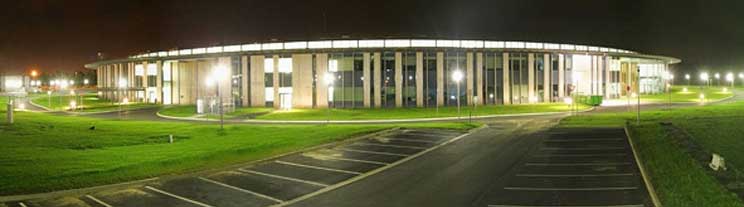
Alma Mater Studiorum, Università di Bologna (UNIBO), IT 

About
The University of Bologna is recognised as the oldest University in
the western world. It is organized in a multi-campus structure
divided into 23 schools, 68 departments and 5 operating
sites.
The scientific research in conservation of cultural heritage
represents a key issue within the University and this is confirmed
by the recent establishment of an Integrated Research Team (IRT)
named ALMA Heritage Science which includes several
departments.
The Microchemistry and Microscopy Art Diagnostic Laboratory (M2ADL)
represents a key representative of the IRT.M2ADL. Its activity
spans to consulting, research, teaching and to the organization of
seminars and specialised meetings, in Italy and abroad. M2ADL
boasts active partnerships both with Italian research groups, such
as the Integrated Research Team “ALMA HeritageScience” of the
University of Bologna, and with international Networks, such as
CHARISMA. The research activity focuses in particular on the
chemical-physical characterization of objects of
historical/artistic/archaeological interest, with particular
attention to detect processes and causes of alteration, test new
materials and restoration methods, identify the chemical-physical
interaction with the substrate and the environment.
Relevant experience and
role
M2ADL will be particularly involved into the activities for the
promotion of the scientific excellence and in e development of
innovative methodologies and instrumentation for laboratory
research.
M2ADL will be responsible for the organization of an advanced
training workshop on Spectroscopic technique. The training workshop
will be aimed at presenting to young scientists, researchers, as
well as conservator-restorers, art historians and archaeologists
the potentialities and most recent and innovative developments of
micro-invasive and non invasive spectroscopic techniques applied to
the study of cultural heritage materials.
Lecturers will be selected both internally and externally to the
CHARISMA consortium. Each laboratory session will also see the
active participation of conservator-restorers who will better
introduce the need for problem-solving approaches in the scientific
examination of different type of heritage materials (such as
paintings, corroded metal/alloys, mosaics, ceramics, glasses,
etc.). During the course a methodological protocol, which
encompasses the use of spectroscopic techniques will be presented
and discussed.
M2ADL is also involved in the identification of organic material in
micro-stratigraphies. In particular the task foresees the
development of new sample pre-treatment methods, testing of new
embedding systems and the study of the effect of polishing methods
on cross sections’ surface morphology.
Besides KBr, the performances of different materials used for cross
section preparation (e.g. dodecane, CsBr, CaF2, BaF2) will be
evaluated. In particular, the attention will be focused on:
humidity absorption, transparency and physical stability of the
system. Moreover, pressure and application time necessary for the
embedding will be optimised for each sample typology, in order to
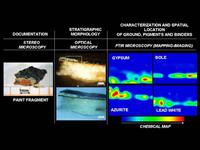
avoid cross section deformation. Optical microscopy observation
(under visible and UV light) will be employed to characterized the
prepared cross sections, as well as µFTIR (imaging/mapping)
analysis performed in different modalities (µATR and reflection)
and other analytical techniques. Different inorganic salts (e.g.
KBr, CsBr, etc.) mixed with metal powders (e.g. Cu) will be
employed and tested as embedding systems for samples collected from
bronze and metal objects. The study will be aimed at characterizing
and spatially locate organic treatments applied on corroded
surfaces. The new embedding system will be aimed at avoiding the
interference of traditional embedding resins as well as specific
problems related to polishing effects, which can occur when hard
samples (such as corroded metal/alloys) are embedded in soft
inorganic salts. Furthermore, available systems for the grinding
and polishing of cross sections (fast ion milling, sample holder
for controlled polishing) will be employed. Samples embedded in
different materials (inorganic salts, polymeric resins) will be
polished under different conditions (wet and/or dry) onto different
substrates (emery papers, metallographic cloths), in order to
define an ad hoc polishing protocol for each embedding system
allowing planar sample surface to be evaluated by the use of
different microscopy techniques (e.g. FTIR, SEM, Raman, SIMS,
etc.).
Website address:
www.unibo.itwww.tecore.unibo.it/html/Lab_Microscopia/M2ADL
Team Leader
Name: Prof Rocco MazzeoAddress: Università di Bologna, Sede di Ravenna, Laboratorio Diagnostico di Microchimica e Microscopia dei Beni Culturali (M2ADL) Via G. Guaccimanni 42, 48100 Ravenna, IT
E-mail: [email protected]

